

It's Construction Safety Week!
We're all in this together, focusing on how we Recognize, Respond, and Respect the serious risks that come with building our world. But while we meticulously plan for physical hazards, there's another, often overlooked, layer of safety being built -- or broken -- every single day: psychological and mental health safety.
Supervisors’ Role in Fostering Psychological and Mental Health Safety
Traditionally, psychological safety, as defined by Amy Edmondson (1999), is "a shared belief held by team members that the team is safe for interpersonal risk-taking." It implies that people will not be punished, humiliated, or rejected for speaking up with ideas, questions, concerns, or mistakes.
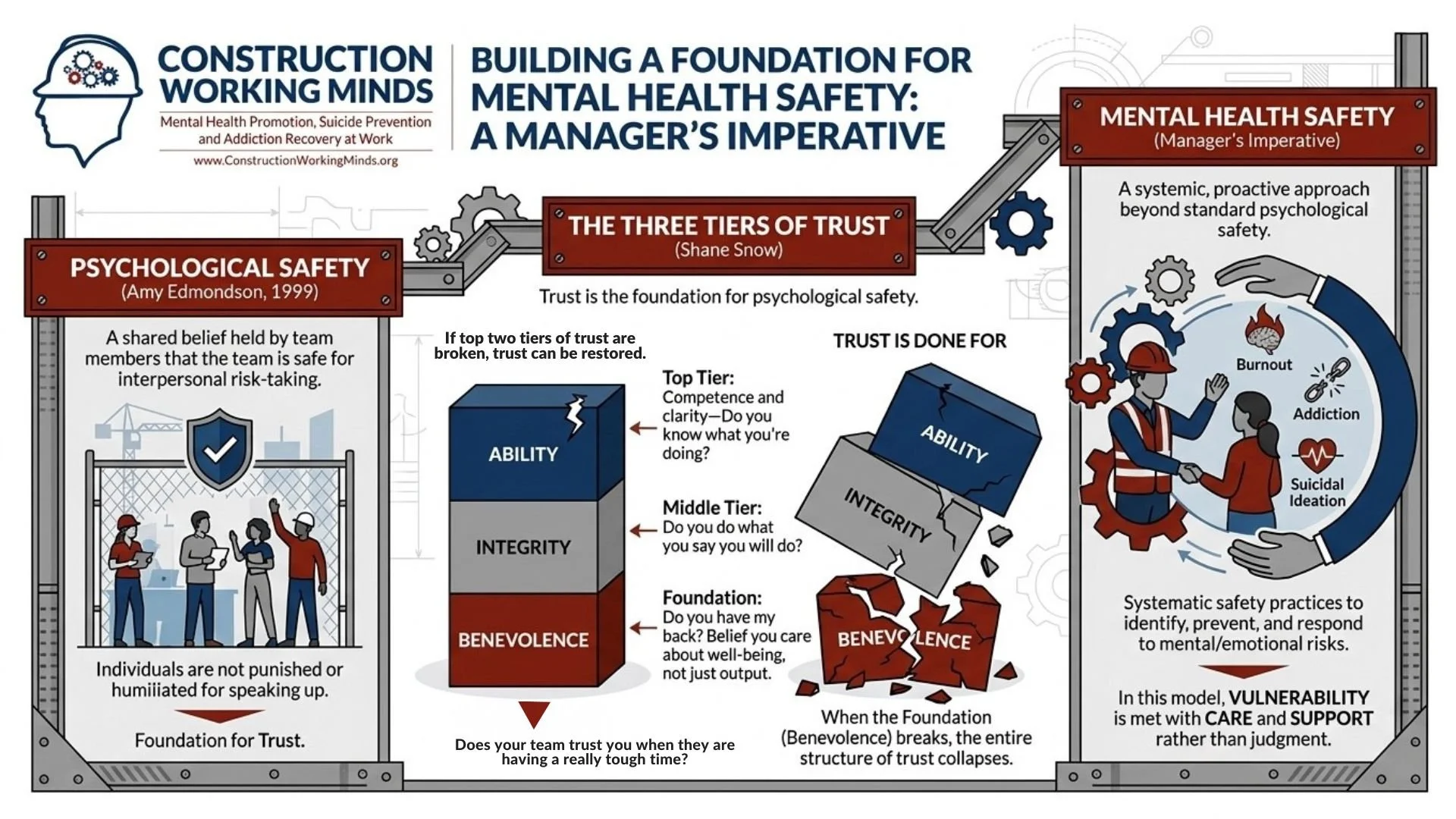
However, when we apply this lens to the high-stakes world of mental wellbeing, we lean into Shane Snow's (2018) profound insight: true psychological safety blossoms when everyone is convinced they'll be treated with benevolence, especially in moments of vulnerability. This means fostering an environment where individuals feel safe to voice struggles with mental health, burnout, addiction, or even suicidal thoughts, trusting they will be met with care, support, and a genuine desire to help, not judgment or professional repercussions.
While psychological safety fosters a team environment where individuals feel safe to take interpersonal risks and speak up without fear of repercussion, mental health safety (as defined in our guide) -
- is a broader, systemic approach: the proactive, systematic application of safety practices to prevent, identify, and respond to mental and emotional risks, protecting workers’ wellbeing through early detection and effective crisis response.
And who are the master builders (or accidental demolition crews) of this unseen structure? Your supervisors.
They’re not just managing tasks; they're setting the tone, shaping the culture, and profoundly impacting the mental wellbeing of every person on their crew. Whether they realize it or not, their actions echo far beyond the project timeline.
Research consistently shows that manager and supervisor behavior is one of the strongest drivers of employee mental health, often more influential than access to care itself (NIOSH, 2024). Let that sink in.
It's not just the benefits package.
It's not just the EAP.
It's not just awareness posters in the break trailer.
It’s the person running the crew. The one who's there, day in and day out, on the ground.
Why Supervisors Are Your Most Critical Safety Asset
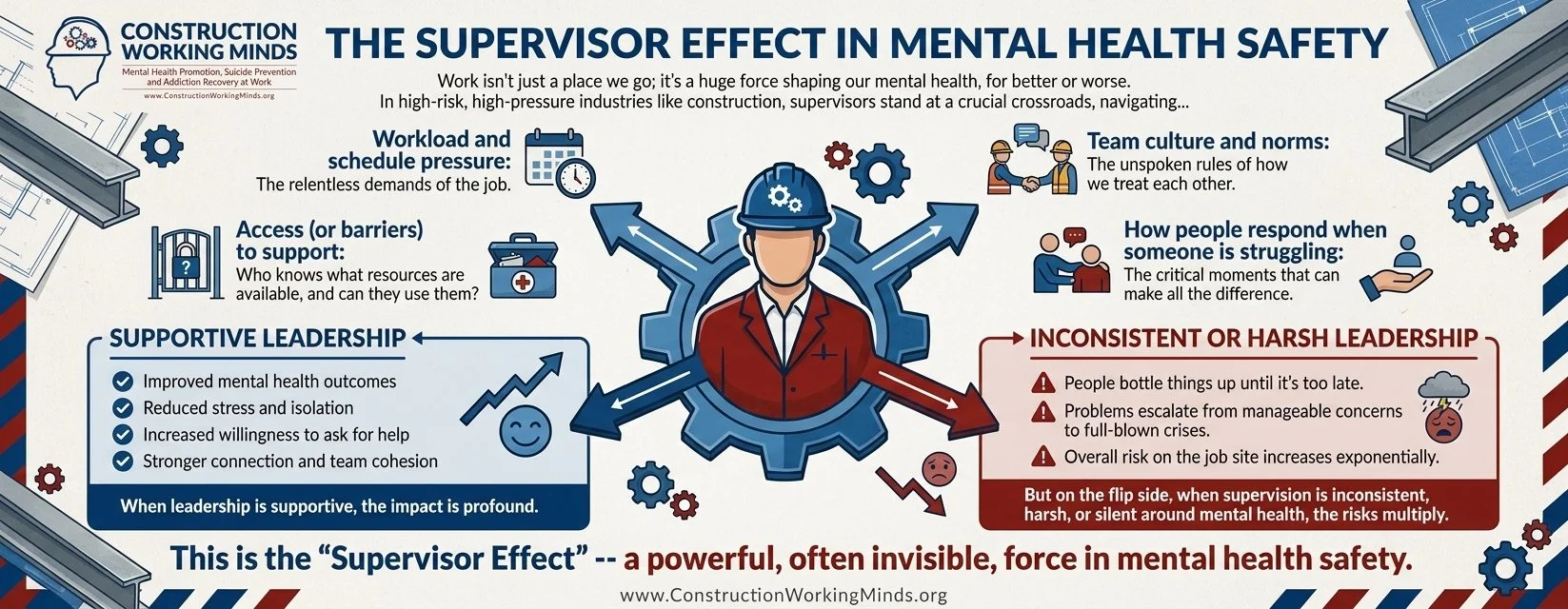
Work isn't just a place we go; it's a huge force shaping our mental health, for better or worse. In high-risk, high-pressure industries like construction, supervisors stand at a crucial crossroads, navigating…
Workload and schedule pressure: The relentless demands of the job.
Team culture and norms: The unspoken rules of how we treat each other.
Access (or barriers) to support: Who knows what resources are available, and can they use them?
How people respond when someone is struggling: The critical moments that can make all the difference.
When leadership is supportive, the impact is profound:
Improved mental health outcomes
Reduced stress and isolation
Increased willingness to ask for help
Stronger connection and team cohesion
But on the flip side, when supervision is inconsistent, harsh, or silent around mental health, the risks multiply:
People bottle things up until it’s too late.
Problems escalate from manageable concerns to full-blown crises.
Overall risk on the job site increases exponentially.
This is the "Supervisor Effect" -- a powerful, often invisible, force in mental health safety.
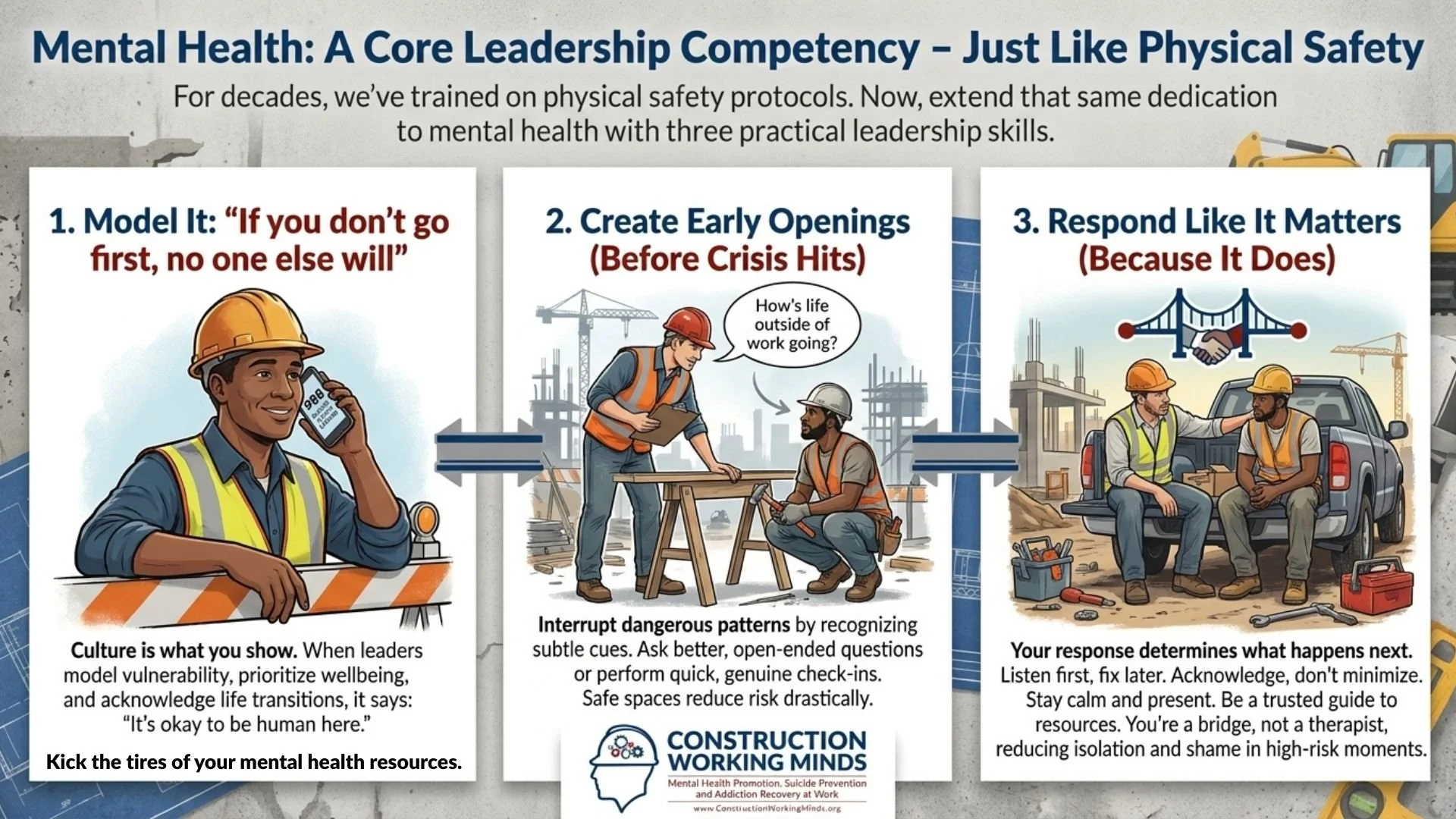
Mental Health: A Core Leadership Competency –Just Like Physical Safety
For decades, we’ve diligently trained supervisors on physical safety protocols. Now, it's time to extend that same dedication to mental health. The good news? This isn’t about turning supervisors into therapists. It’s about equipping them with three practical, actionable leadership skills.
1. Model It: “If you don’t go first, no one else will”
Culture isn’t what you say; it’s what you show. When leaders genuinely:
Talk openly about their own stress (appropriately, of course)
Prioritize their wellbeing by taking time off when needed
Share (again, appropriately) how they use support resources like counseling or peer support
Acknowledge tough life transitions that affect everyone
…it sends an unmistakable message: "It’s okay to be human here." When leaders model vulnerability, it actively lowers that barrier. They're showing respect for the whole person.
2. Create Early Openings (Before Crisis Hits)
Most people don’t go from "fine" to "crisis" overnight. But they often stay quiet… until things become critical. Supervisors can interrupt this dangerous pattern by learning to recognize the subtle cues:
Asking better, more open-ended questions like, "How’s life outside of work going these days?"
Doing quick, genuine check-ins (even 5 minutes can be transformative).
Noticing subtle changes in behavior, mood, or performance.
Actively making it safe to speak up early.
Because once someone feels safe enough to say, "Hey, I’m not doing great," you've already dramatically reduced risk. You’ve recognized the potential hazard and opened the door for intervention.
3. Respond Like It Matters (Because It Does)
When someone opens up -- even a little -- the response they receive can determine everything that happens next. Employees often hesitate to disclose distress because they fear being dismissed, judged, or unsupported. A strong, empathetic supervisor response looks like:
Listen first, fix later: Don’t jump to solutions; just hear them out.
Acknowledge, don’t minimize: Validate their feelings, don't brush them off.
Stay calm and present: Your demeanor can de-escalate anxiety.
Be a trusted guide to resources: You're not their therapist, but you can be a warm bridge.
In higher-risk moments, knowing how to respond quickly and compassionately can literally reduce isolation and shame, two key drivers of suicide risk. You’re putting direct controls in place through human connection.
The Bottom Line: Invest in Your Supervisors, Invest in Your People
If you want to genuinely move the needle on mental health and suicide prevention in construction, start with your supervisors.
Not as a checkbox. Not as a one-time training. But as a core leadership skill, just like physical safety, productivity, and quality.
Ready to Empower Your Leaders?
We understand the unique challenges of the construction industry. That's why we've had the privilege of working with dozens of contractors and unions across the US and Canada, including major data center sites, to build this critical capability at scale.
Our "Advanced Skills for Managers Training" focuses on these exact, practical skills. We offer flexible options to fit your needs:
Half-day and Full-day formats
Virtual and In-person delivery
Part 1 (foundational) and a refresher Part 2 (see attached descriptions for full details)
This is an actionable training that empowers your supervisors to build a safer, more supportive workplace.
If you’re thinking about how to strengthen your supervisors’ role in mental health and suicide prevention, we’re happy to share what's working (and what's not) and explore how our programs can benefit your team.
References
Edmondson, A. C. (1999). Psychological safety and learning behavior in work teams. Administrative Science Quarterly, 44(2), 350–383. https://doi.org/10.2307/2666999
Greiner, B. A., Leduc, C., O’Brien, C., Cresswell-Smith, J., Rugulies, R., Wahlbeck, K., et al. (2022). The effectiveness of organisational-level workplace mental health interventions on mental health and wellbeing in construction workers: A systematic review and recommended research agenda. PLOS ONE, 17(11), e0277114. https://doi.org/10.1371/journal.pone.0277114
Hammer, L. B., Dimoff, J. K., Mohr, C. D., & Allen, S. J. (2024). A framework for protecting and promoting employee mental health through supervisor supportive behaviors. Occupational Health Science. https://doi.org/10.1007/s41542-023-00171-x
McGrath, M. O., et al. (2026). Developing guidelines for supporting employees disclosing suicidal distress while working: A Delphi study. BMC Public Health. https://pmc.ncbi.nlm.nih.gov/articles/PMC13014722/
National Institute for Occupational Safety and Health. (2024). Mental health in the workplace. Centers for Disease Control and Prevention. https://www.cdc.gov/niosh/bulletin/2024/mental-health-work.html
Nwaogu, J. M., et al. (2022). Conceptualizing the dynamics of mental health in the workplace. https://ira.lib.polyu.edu.hk/bitstream/10397/96701/1/Nwaogu_Conceptualizing_Dynamics_Mental.pdf
Snow, S. (2018).3 charts about trust and 1 burning question. Shane Snow’s Content Strategy & Culture. https://stack.shanesnow.com/p/3-charts-about-trust-and-1-burning
World Health Organization. (2024). Mental health at work. https://www.who.int/news-room/fact-sheets/detail/mental-health-at-work