

You know that feeling. You have answered 47 emails, bounced from meeting to meeting, put out fires, and crossed a dozen things off your list. And yet, at the end of the day, you are exhausted and wondering: what did I actually accomplish? And more importantly, did I give any energy to the things and the people who matter most?
My guest today, Dr. Abby Medcalf, has a reframe for burnout that stopped me in my tracks the moment I heard her keynote at the Employee Assistance Professionals Conference in San Francisco. She says we have been asking ourselves the wrong question. Instead of asking "Do I have time for that?" we need to start asking "Do I have the mind for that?" Because it is our attention -- not just our time -- that is one of our most precious resources. And when we are constantly giving it away, there is not much left for creativity, connection, or the things that give our lives meaning.
Dr. Abby Medcalf is a straight-talking psychologist, number one Amazon bestselling author, speaker, and host of two top-rated podcasts -- Relationships Made Easy and Workplace Therapy with Dr. Abby Medcalf -- heard in over 190 countries. With over 35 years of experience and a background in both counseling psychology and organizational psychology, she brings the science to life in a way that is immediately useful.
In this episode, Abby and I talk about the science of attention, why willpower is an exhaustible resource, the critical difference between rest and real recovery, and the specific habits that actually rebuild your mental bandwidth. This conversation is as much about reclaiming your life as it is about preventing burnout. I took so many notes. I think you will too.
why this episode matters
We are living through a moment of collective depletion. The demands on our attention have never been higher -- notifications, news cycles, the blurred line between work and home, the relentless pressure to do more and be more -- and the conventional answer has always been time management. Work smarter. Prioritize better. Use a better planner.
What Abby Medcalf is naming -- and what this conversation helped me articulate more clearly than ever -- is that the problem is not how we organize our hours. The problem is that we have treated our mental and emotional energy as infinite, and it is not. Burnout is not a scheduling failure. It is a bandwidth crisis.
This reframe matters because the solutions that follow from it are completely different. You cannot schedule your way out of a willpower deficit. You cannot discipline yourself into having more units than you woke up with. But you can protect the units you have, build habits that replenish them, ask for help during hard seasons without shame, and design your environment -- your commute, your mornings, your communication channels -- to work with your biology instead of against it.
For anyone who has ever felt like they were failing at a life that looked manageable on paper, this conversation is a permission slip and a practical guide at the same time. I am grateful Abby brought it to Hope Illuminated.
Questions This Episode Answers
What is attention management and how is it different from time management?
Why does willpower run out during the day and what can you do about it?
What is the difference between rest and recovery, and why does it matter for burnout?
How does sleep affect willpower and mental bandwidth?
What are practical ways to protect your attention and reduce decision fatigue at work?
Key Themes & Insights
Stop Managing Your Time and Start Managing Your Attention
The central reframe of this entire conversation is one I think every high-achiever needs to hear: burnout is not a time management problem. It is an attention management problem. We plan our days on 24 hours, filling every slot with tasks and obligations, and then wonder why we cannot execute even when the calendar looks doable. Abby's answer is to stop asking "Do I have time for that?" and start asking "Do I have the mind for that?" Willpower, our capacity to focus, make decisions, resist distraction, and handle frustration, is a finite resource that depletes across the day. When it is gone, it is gone. The goal is not to squeeze more into the same hours. The goal is to protect and replenish the mental bandwidth those hours require.
Willpower Is Exhaustible and Almost Everything Drains It
About 90% of the research supports the idea that willpower is an exhaustible resource and the things that drain it are far more numerous than most of us realize. Every decision. Every frustration. Every commute. Every new behavior we are trying to build. Every stressor in our personal lives, from a family member's illness to a looming root canal. Abby uses the vivid metaphor of "willpower units" -- we all wake up with a certain number based on our sleep, stress levels, habits, and life circumstances, and we spend them down across the day. The implication is profound: if your plate is already full with a death in the family, a loved one in crisis, or a health issue, and you add a new project on top, you are not being lazier than someone whose plate is emptier. You are running on a smaller bank, and no amount of discipline will manufacture units you do not have.
Sleep Is the Single Most Powerful Willpower Restorer
Of all the habits that increase our willpower units - meditation, exercise, eating well, reducing stress, addressing medical issues - Abby is clear that sleep is number one, and it is not close. We all know what it feels like to wake up after real sleep versus a poor night. The steel cut oats versus the three cups of coffee. What most people miss is the vicious cycle underneath: when we are depleted, we crave the late-night scroll or the Netflix binge because those feel like "me time." But doom scrolling and binge watching are rest, not recovery. Sleep is recovery. Talking to a good friend is recovery. A community meeting or a meaningful conversation -- these are recovery. Rest feels good in the moment but does not replenish the bank. Recovery does. Abby's challenge to her clients: go to bed earlier for 90 days and notice how little you need the doom scroll when you are not running on empty.
When Your Plate Is Overflowing, Add Resources, Not Discipline
One of the most practical sections of this conversation is Abby's "plus or minus" framework for life's hard seasons. When you are dealing with a death, a health crisis, a family member in distress, when your plate is already overflowing, the answer is not more discipline. It is adding external resources and subtracting unnecessary obligations. Abby's specifics are worth writing down: get a cleaning person even just for a few weeks; have them do your laundry while they are there; carpool with another parent to open up two mornings a week; ask a sibling or friend to walk the dog for a month. And critically, do not ask your partner to pick up the slack. You are a shared battery. When you are depleted, they feel it too. Look outside the relationship for support during hard seasons. This is not weakness. It is intelligent bandwidth management.
Protect Your Creative Morning Hours -- and Funnel Your Attention
Abby's most counterintuitive practical recommendation: never start your day with email. Email is other people's agenda. If you open your inbox first, you have already spent your highest-bandwidth hours on someone else's priorities. Instead, she reserves the early hours for creative work -- podcast episodes, writing, the things that require her best thinking -- and only checks email twice a day, at around 10am and 3pm. Beyond that, she deliberately funnels all communication into as few channels as possible (primarily email) so her attention is not scattered across Slack, text, voicemail, LinkedIn DMs, and everything else simultaneously. The research she cites is striking: just having your phone visible on your desk (even face down) measurably reduces your effectiveness. And attention residue, the mental cost of switching between tasks, can reduce productivity by up to 400%. Protecting your attention is not a luxury. It is the work.
about ABBY MEDCALF
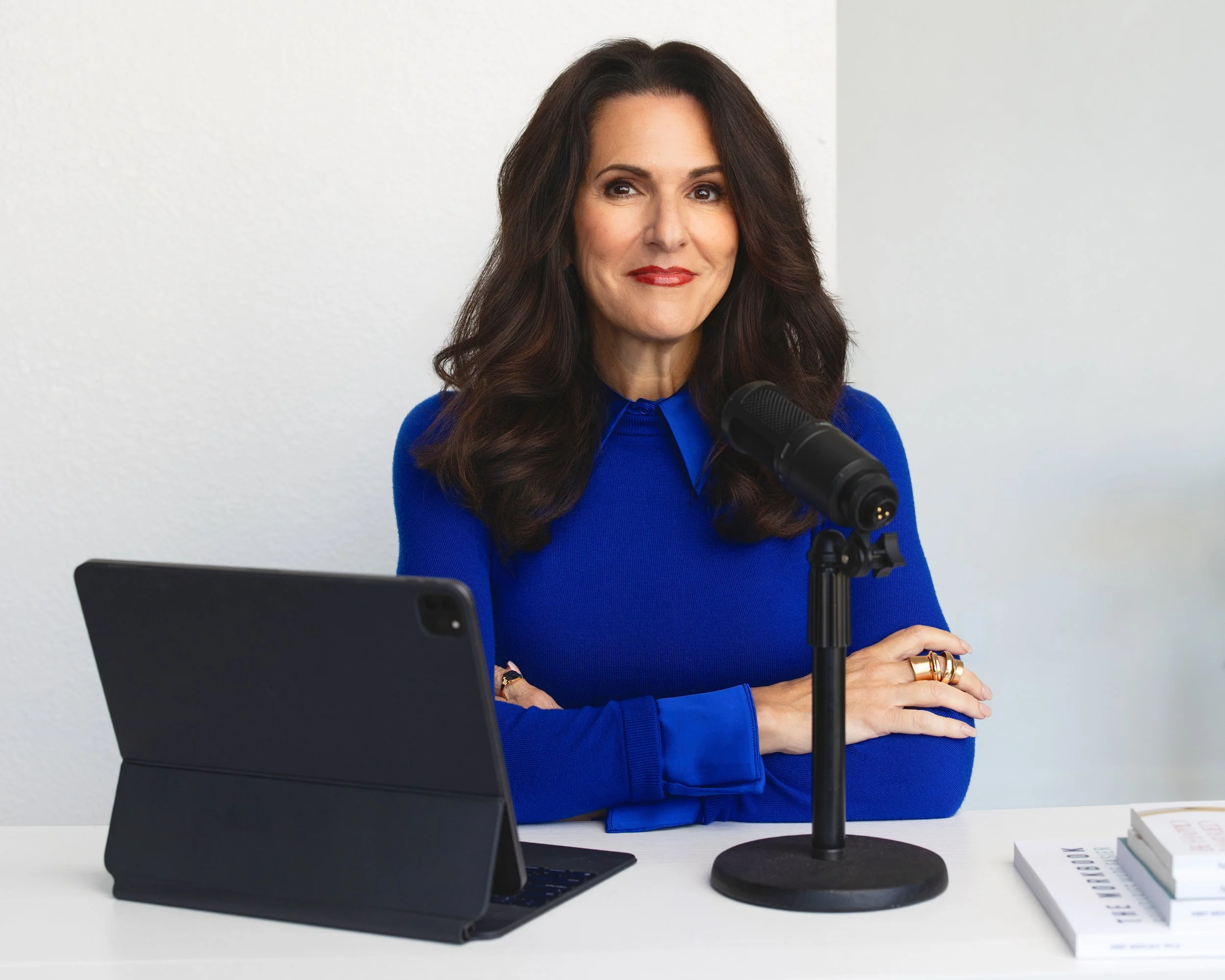
Dr. Abby Medcalf is a straight-talking psychologist, bestselling author, speaker, and podcast host who helps people become confident, direct communicators in every relationship -- whether it is with a partner, a coworker, or their own inner critic. With over 35 years of experience, a master's in counseling psychology, and a PhD in organizational psychology, Abby blends science-backed strategies with humor, candor, and just the right amount of bossy.
She is the author of the number one Amazon bestseller Be Happily Married, Even if Your Partner Won't Do a Thing, along with Boundaries Made Easy and The Boundaries Made Easy Workbook. Her top-rated podcasts, Relationships Made Easy and Workplace Therapy with Dr. Abby Medcalf, are heard in over 190 countries. She has been a featured expert on CBS and ABC, and her work has appeared in the New York Times, Women's Health, Fast Company, Success Magazine, Psychology Today, and the Wall Street Journal.